SOCIOLINGUISTICS

What is the relationship between
society and language?
The relationship between language
and society is one that can vary from culture to culture. Language and society
is tightly anchored, and the relationship is also deeply rooted in most
cultures and societies. If either one of these is used inappropriately, it can
cause great change in perception, or point of view, as well as change the way
that conflict is resolved. Language really helps people to grasp social values,
which is important to most.
Reference:
merlitomarciano.wordpress.com
If we talk about the same language,
why do you think it varies from one place to another?
.svg/300px-Spanish_speakers_in_the_Americas_(orthographic_projection).svg.png)
There are about 70 million deaf
people who use sign language as their first language or mother tongue. It is
also the first language and mother tongue to many hearing people and some deaf
blind people (tactile sign languages). Each country has one or sometimes two or
more sign languages, although different sign languages can share the same
linguistic roots in the same way as spoken languages do.
Besides the place, what other
things do you think affects the way we speak?
Understand variations in spoken
language, explaining why language changes in relation to contexts
Evaluate the impact of spoken language choices
in your own and others ‘use
Language is a social factor. The
languages of developed societies - let's call it Civilization - all distinguish
between more and less refined or elevated speech. Whether a speaker is educated
will be obvious from his speech, and his economic status, geographical and
ethnic background may be deduced.
Politics inevitably infects the
language. Most Americans of a certain age struggle not to say some words that
were ok a while ago. And it works both ways. Language affects social behavior.
For example, we say we ride a bicycle, even though we drive it (our legs are
pistons delivering power through the chain to the driving wheel), and so
bicyclists in traffic are understood to be harmless, charming eco-champions
instead of the worst drivers the world has ever seen. All because the first
bicycles had no pedals, and all you could do was ride
Social factors may affect your
language, depending on your status in society, for example if you are poor and
cannot afford an education or you were raised to believe schooling wasn't
important or you grew up in a rural area where proper grammar wasn't
encouraged, your way of speaking might be different or not as eloquent as
opposed to someone of higher standing.
What is the difference between
accent and dialect?
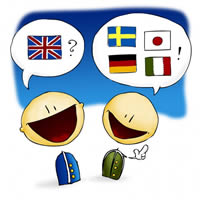
Accent and dialect are two
different words that are commonly heard in linguistics. These two words refer
to a certain way of speaking a language and are often confused, resulting in
being used interchangeably; however both the words have different meanings.
Accents are usually considered as a subset of dialects and are gaining
popularity due to the increase in international Business Process Outsourcing
(BPO) companies. Due to the outsourcing, a lot of people look for people with
an American accent to work at such places.
an accent depends mostly on
pronunciation of specific words or phrases. An accent is the manner in which
different people pronounce words differently from each other. Accents differ
depending on a particular individual, location, or nation. The accent can also
help identify the locality, region, the socio-economic statues, the ethnicity,
caste and/or social class of the speaker. All these factors affect the accent
of a person
A dialect is a variation in the
language itself and not only in the pronunciation. Dialect is a type of
language that is derived from a primary language. For example, Sanskrit being a
primary language, Hindi, Marathi and Gujarati are all considered as dialects of
that particular language. It is used to refer to the language that deviates
from the original language. The second language differs with regards to
grammar, pronunciation, vocabulary, etc. In certain cases, a mix of two
languages is also considered as a dialect, such as Spanglish is considered as a
dialect of Spanish and English.
Covert Prestige
Prestige associated with that choice is gained from
within social group identification.
In sociolinguistics, the degree of esteem and social
value attached by members of a speech community to certain languages, dialects,
or features of a language variety.
Overt prestige:
Overt prestige: the status of a speech style or
feature that is generally recognized as “better” or more positively valued in
the larger community, in contrast to covert prestige.
Overt prestige' and 'covert
prestige' are terms usually used to refer to dialects. An overt prestige
dialect is generally one that is widely recognized as being used by a
culturally dominant group. In England, this would be RP. In the US, the
Midwestern standard. A covert prestige dialect, on the other hand, is one that
is generally perceived by the dominant culture group as being inferior but
which compels its speakers to use it to show membership in an exclusive
community. In this way, covert prestige can be likened to 'street cred': If you
talk street, you may not be accepted by the power majority, but you earn
respect among those who reject the values of that power majority.
Pidgin language (origin in Engl. word `business'?) is
nobody's native language; may arise when two speakers of different languages
with no common language try to have a makeshift conversation. Lexicon usually
comes from one language, structure often from the other. Because of
colonialism, slavery etc. the prestige of Pidgin languages is very low. Many
pidgins are `contact vernaculars', may only exist for one speech event.
Creole language (orig. person of European descent born and
raised in a tropical colony) is a language that was originally a pidgin but has
become nativized, i.e. a community of speakers claims it as their first
language. Next used to designate the language(s) of people of Caribbean and
African descent in colonial and ex-colonial countries (Jamaica, Haiti,
Mauritius, Réunion, Hawaii, Pitcairn, etc.)

No comments:
Post a Comment