MORPHOLOGY

Morphology is a field of
linguistics focused on the study of the forms and formation of words in a
language. A morpheme is the smallest indivisible unit of a language that
retains meaning. The rules of morphology within a language tend to be
relatively regular, so that if one sees the noun morphemes for the first time,
for example, one can deduce that it is likely related to the word morpheme.
POLYSYNTHETIC
LANGUAGES
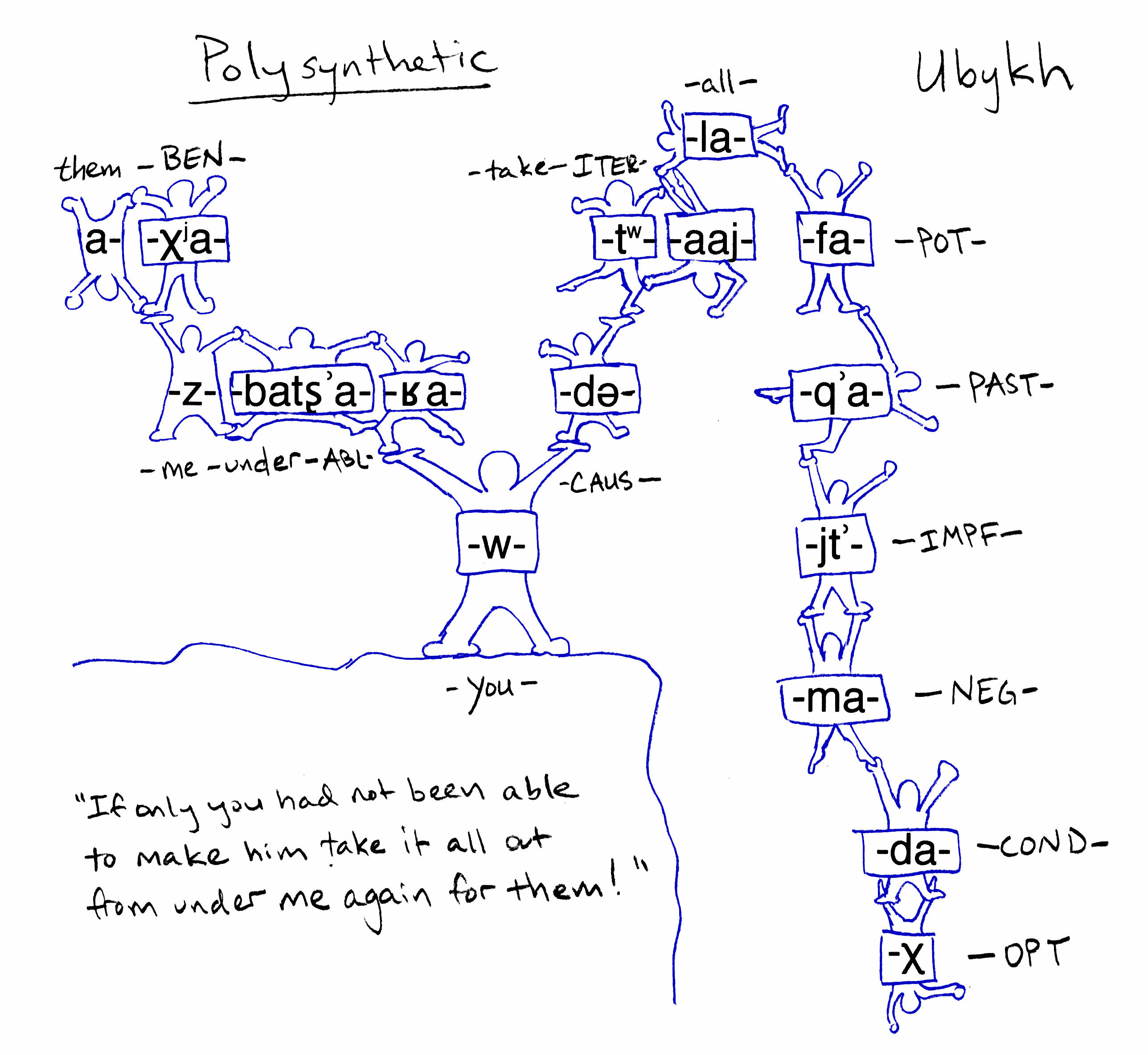
Polysynthetic languages are
languages that allow the formation of extremely long and complex words that are
built up spontaneously out of many smaller parts. One such word can typically
be the functional equivalent of an entire sentence in a language like English.
For example, a speaker of the Mohawk language might make up the word
wahonwatia'tawitsherahetkenhten', and this would immediately be understood by
other Mohawk speakers as meaning "She made the thing that one puts on
one's body ugly for him."
The study of polysynthetic
languages has been important for several reasons. First, they present an
excellent way of exploring the relationships between the different branches of
linguistics. In particular, ideas about the connections between SYNTAX and
MORPHOLOGY are well studied by looking at these languages, because they seem to
use a different division of labor from languages like English, with more burden
on morphology and less on syntax. Thus, the study of such languages has led to
new proposals about the relationship between these components (e.g., Sadock
1980, 1985; Baker 1988). These languages also raise interesting questions about
the LEXICON and its relationship to both syntax and morphology, because it is
clear that speakers of a polysynthetic language cannot possibly learn more than
a tiny fraction of the expressions that count as words in their language.
INFLECTED LANGUAGE
A fundamental concept in
linguistic typology and the morphological classification of languages,
referring to a language in which words are altered or formed chiefly by means
of inflection.
Inflected languages are divided
into two generally overlapping subclasses—those with internal and those with
external inflection. External inflection, in contradistinction to affixation,
is characterized by polysemy, as well as by fusion with the stem, which is
expressed by alternation at the morpheme boundary, an example of polysemy may
be found in the form ruk-oi (“by hand”), where the morpheme -oi indicates
feminine gender, singular number, and the instrumental case. Internal
inflection refers to positionally unconditioned vowel gradation within
morphemes that has grammatical meaning, as in the German geht (“goes”), ging
(“went”), der Gang (“a stroll”), or the Arabic thahab-a (“was walking”) and
thihāb (“the process of walking”). The mechanism of internal inflection is
particularly evident in the morphology of the verb, as in ablaut in German and
the verb categories of the Semitic languages. Inflection is almost always
combined with other formal modes of expressing meaning.
ISOLATING
LANGUAGE
An isolating language is a type
of language with a low morpheme-per-word ratio – in the extreme case of an
isolating language, words are composed of a single morpheme.
A closely related concept is the
analytic language, which in the extreme case does not use any inflections to
indicate grammatical relationships (but which may still form compound words or
may change the meanings of individual words with derivational morphemes, either
of which processes gives more than one morpheme per word).
Isolating languages are in
contrast to synthetic languages, where words often consist of multiple
morphemes.[1] That linguistic classification is subdivided into the
classifications fusional, agglutinative, and polysynthetic, which are based on
how the morphemes are combined.
Word
|
Definition
|
Example
|
Morpheme
|
a meaningful morphological unit of a language that cannot be further divided
|
in, come, -ing, forming incoming
|
Free Morpheme
|
A free morpheme is a small linguistic unit with meaning assigned to it(i.e. a morpheme)
|
e.g. time, llama, bed
|
Bound Morpheme
|
(chair and man)
| |
Prefix
|
A prefix is placed at the beginning of a word to modify or change its meaning
|
atheist, anaemic
|
Suffix
|
Common examples are case endings, which indicate the grammatical case of nouns or adjectives, and verb endings, which form the conjugation of verbs
|
comforting and comfortable
|
Infix
|
The word Infix means to fix in the mind or to instil. An example of a sentence with the word infix is: Infix a picture into the text. Synonyms to the word Infix include insert, introduce, and enter.
|
Minne⟨flippin'⟩sota
|
Affix
| ||
Derivational Morpheme
| ||
Inflectional Morpheme
|
Inflectional morphemes serve as grammatical markers that indicate tense, number,possession, or comparison.
|
Observations, below.
|

No comments:
Post a Comment